Home
News & Updates
AI Adoption Gains Momentum among Hong Kong Businesses as Platforms, Governance and Talent Become Key to Competitiveness
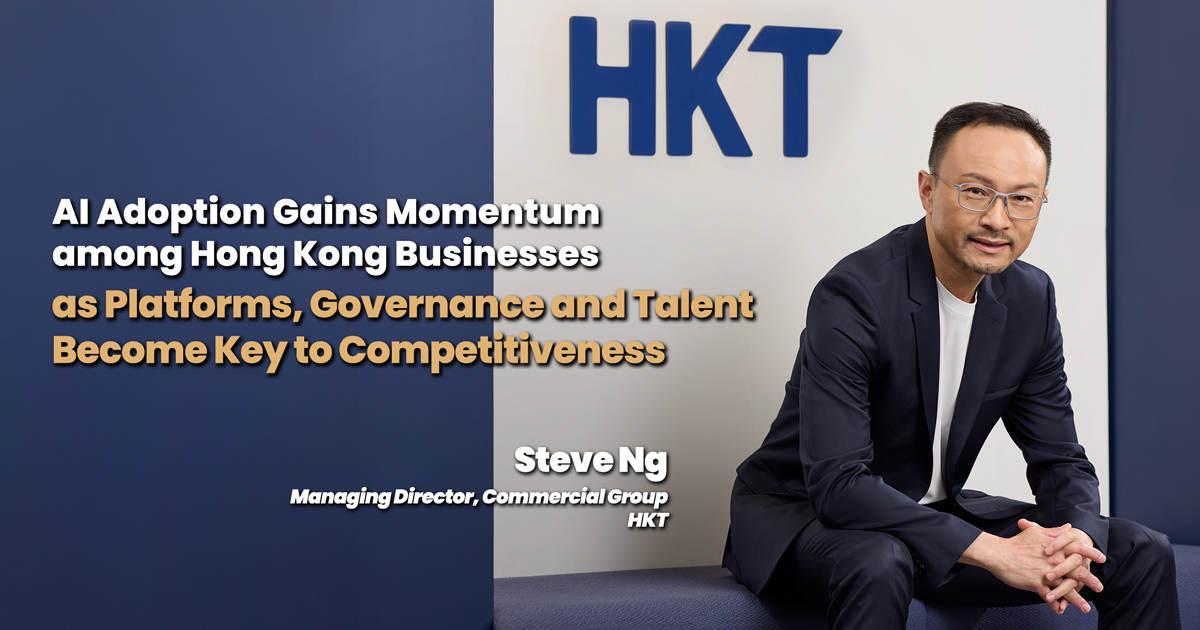
Artificial intelligence (AI) has moved beyond being a technology issue and onto the decision-making agenda of senior management teams. HKT’s latest “Hong Kong Business AI Adoption Survey Report in 2026” shows that 67% of respondents have implemented, are piloting or plan to use AI. The figure rises to 79% among large enterprises, compared with 65% among mid-market businesses and 49% among SMEs.
Market focus has shifted from whether businesses should adopt AI to how AI can be integrated into daily operations and translated into measurable business capabilities that can scale sustainably. As AI adoption becomes more widespread, the next phase of competition will depend not on how many AI tools an organisation has, but on whether it can establish a comprehensive platform and develop unified management and execution capabilities.
From Single-Point Solutions to Platform-based Deployment: Optimising Total Cost of Ownership
Among the companies surveyed, 52% identified improving overall operational efficiency as their primary objective for adopting AI. The most commonly implemented are typically those where return on investment (ROI) can be measured more readily, such as chatbots, virtual assistants and Robotic Process Automation (RPA).
This indicates that businesses often begin AI adoption with use cases that can deliver results more quickly. However, moving from pilot projects to adoption at scale also requires a shift from single-point solutions towards platform-based planning and deployment.
When individual departments procure tools independently in response to immediate needs, this may lead over time to duplicated tools, fragmented data, integration difficulties and higher upgrade costs, increasing Total Cost of Ownership (TCO). AI deployment should therefore move beyond isolated applications towards a reusable, centrally managed and scalable platform model.
Agentic AI Tests Enterprise-wide Deployment Capabilities
The proportion of businesses planning to adopt Agentic AI increases with company size. Nearly 40% of large enterprises plan to adopt Agentic AI in the future, roughly double the proportion among SMEs. This reflects growing expectations for AI to advance beyond chatbots into systems that can plan the steps required to achieve defined objectives and execute tasks accordingly.
However, Agentic AI is not simply another software feature. Without integrated data, standardised processes and clearly defined access controls, businesses will struggle to deploy AI to execute workflows within a controlled environment.
A range of solutions can already be integrated quickly into daily work, including Microsoft Copilot, ready-to-use Agentic AI workflows and Edge AI. These allow businesses to begin with lower-risk use cases where results are easier to quantify. Scaling adoption further, however, still requires secure infrastructure, data governance, systems integration and human oversight.
Coordinating Cost, Privacy, Private AI Deployment and Talent Development to Build Sustainable AI Platform Capabilities
The survey shows that 82% of respondents consider data privacy important, while most are already using, exploring or planning to deploy Private AI. Based on data sensitivity, performance and regulatory requirements, businesses can build a hybrid architecture combining enterprise-grade Private Cloud, on-premises deployment and Edge AI.
This approach is particularly important for industries that place a strong emphasis on compliance and control. It also reflects a broader shift in how businesses evaluate AI, moving beyond functionality alone to consider data residency, governance, security and deployment models.
At the same time, 82% of respondents have allocated budgets or developed plans for AI investment over the next 12 months, while 69% identify cost and return on investment (ROI) as the most important purchasing considerations. Given the costs associated with computing power, infrastructure, integration and management, businesses need to begin with high-value use cases that can demonstrate results more quickly while avoiding fragmented and short-term investment decisions. Technology deployment must also progress alongside processes of redesign, talent development and human-AI collaboration.
The next phase of AI competition will depend on whether businesses can balance cost, governance, platforms and talent while establishing a sustainable deployment model. Businesses should begin with high-ROI use cases and combine enterprise-grade networks, Private AI infrastructure, application integration capabilities and talent development to expand adoption progressively.
Through this approach, businesses can move beyond isolated AI pilot projects and embed AI in business processes as a long-term capability that improves efficiency, supports decision-making and drives business growth.
Source: 《香港企業 AI 應用熱度升溫 平台、管治與人才成競爭關鍵》Steve Ng's Editorial on EDigest, 13 August 2026. Translated by 1O1O Corporate Solutions.